DTSA 5301 - Shooting Data
knitr::opts_chunk$set(echo = TRUE)
# Necessary Packages
library(tidyverse)
library(ggplot2)
library(fastDummies)
library(rworldmap)
library(lubridate)
City of New York Shooting Data
For this project, I decided to focus my analysis on answering the question: Have shootings and murders decreased over time in New York? I think there are a lot of different ways to slice the data and investigate both the overall result, as well as population specific results.
This data is provided directly from the City of New York City. The data itself comes from the New York Police Department (NYPD) and will record one row per shooting incident.
Import & Read Data
Importing directly from the site.
url_in <- "https://data.cityofnewyork.us/api/views/833y-fsy8/rows.csv"

shooting <- read_csv(url_in)
Tidying Data
# Removing coordinates
shooting1 <- shooting %>% select(-c(X_COORD_CD, Y_COORD_CD))

# Mutating dates, additional columns
shooting1 <- shooting1 %>% mutate(DATE_TIME = as.POSIXct(paste(OCCUR_DATE," ",OCCUR_TIME),format = "%m/%d/%Y  %H:%M:%S")) %>% mutate(SAME_AGE_GROUP = case_when(PERP_AGE_GROUP == VIC_AGE_GROUP ~ 1, TRUE ~ 0)) %>% mutate(SAME_SEX = case_when(PERP_SEX == VIC_SEX ~ 1, TRUE ~ 0)) %>% mutate(SAME_RACE = case_when(PERP_RACE == VIC_RACE ~ 1, TRUE ~ 0)) %>% mutate(MURDER = case_when(STATISTICAL_MURDER_FLAG == TRUE ~ 1, TRUE ~ 0)) %>%
  mutate(YEAR = year(DATE_TIME), MONTH = month(DATE_TIME), WEEK_DAY = wday(DATE_TIME))

# Dummy columns for categorical data
shooting2 <- dummy_cols(shooting1, select_columns = c('PERP_AGE_GROUP', 'PERP_SEX', 'PERP_RACE', 'VIC_AGE_GROUP', 'VIC_SEX', 'VIC_RACE'), remove_selected_columns = FALSE)
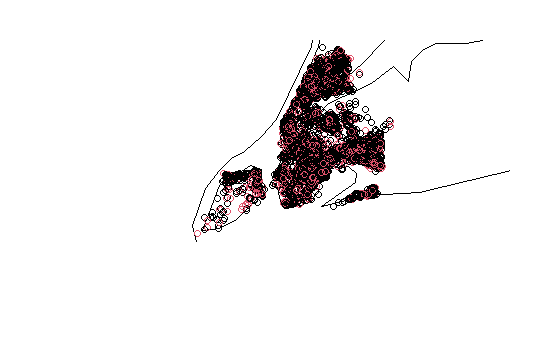
Mapping Incidents (for fun!)
nyc_map <- getMap(resolution = 'low')
nyc_map_plot <- plot(nyc_map, xlim= c(min(shooting2$Longitude),max(shooting2$Longitude)), ylim= c(min(shooting2$Latitude),max(shooting2$Latitude))) + points(shooting2$Longitude, shooting2$Latitude, col= factor(shooting2$MURDER))
Analyzing Data
# Summarizing shootings by year and borough
shootings_year_b <- shooting2 %>% group_by(YEAR, BORO) %>% summarize (
  total = n(),
  murders = sum(MURDER, na.rm=T),
  perp_m = sum(PERP_SEX_M, na.rm=T),
  perp_f = sum(PERP_SEX_F, na.rm=T),
  vic_m = sum(VIC_SEX_M, na.rm=T),
  vic_f = sum(VIC_SEX_F, na.rm=T)
)

# Adding in percent columns
shootings_year_b <- shootings_year_b %>% mutate(pct_murder = murders/total, pct_perp_m = perp_m/total, pct_perp_f = perp_f/total, pct_vic_m = vic_m/total, pct_vic_f = vic_f/total)

shootings_year_b
| YEAR |
BORO |
total |
murders |
perp_m |
perp_f |
vic_m |
vic_f |
pct_murder |
pct_perp_m |
|---|---|---|---|---|---|---|---|---|---|
| 2006 | BRONX | 568 | 137 | 450 | 9 | 511 | 57 | 0.24119718 | 0.7922535 |
| 2006 | BROOKLYN | 850 | 176 | 637 | 4 | 784 | 66 | 0.20705882 | 0.7494118 |
| 2006 | MANHATTAN | 288 | 60 | 213 | 4 | 262 | 26 | 0.20833333 | 0.7395833 |
| 2006 | QUEENS | 296 | 59 | 229 | 3 | 276 | 20 | 0.19932432 | 0.7736486 |
| 2006 | STATEN ISLAND | 53 | 13 | 45 | 2 | 40 | 13 | 0.24528302 | 0.8490566 |
| 2007 | BRONX | 533 | 93 | 425 | 9 | 486 | 46 | 0.17448405 | 0.7973734 |
| 2007 | BROOKLYN | 833 | 177 | 586 | 13 | 765 | 67 | 0.21248499 | 0.7034814 |
| 2007 | MANHATTAN | 233 | 46 | 182 | 3 | 217 | 14 | 0.19742489 | 0.7811159 |
| 2007 | QUEENS | 238 | 48 | 162 | 5 | 210 | 28 | 0.20168067 | 0.6806723 |
| 2007 | STATEN ISLAND | 50 | 9 | 43 | 2 | 43 | 7 | 0.18000000 | 0.8600000 |
Note: this is a subset of the full table results.
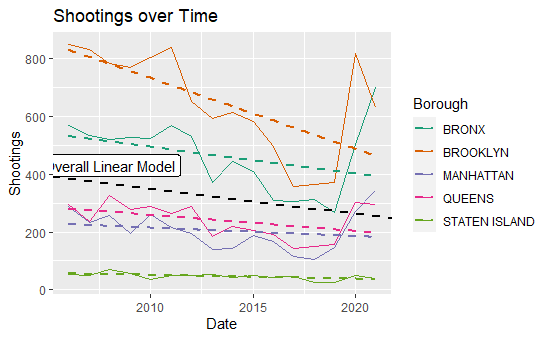
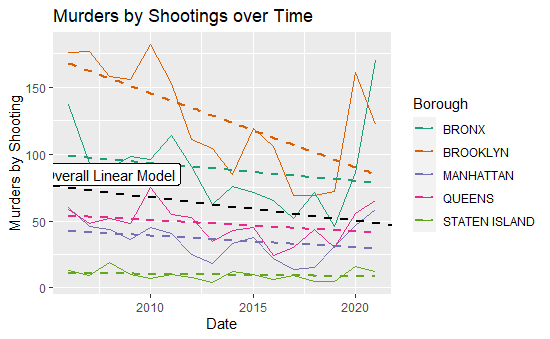
2006 in Brooklyn had the most overall shootings (by borough and year) at 850. The top 7 results by total shooting are all Brooklyn (2006, 2011, 2007, 2020, 2010, 2008, 2009). By murders, Brooklyn takes the top 3 spots (2010, 2007, and 2006 respectfully), but the fourth highest is the Bronx in 2021. In contrast, the lowest amount of shootings was Staten Island in 2006.
Modeling
mod_shootings <- lm(total ~ YEAR, data = shootings_year_b)
mod_murders <- lm(murders ~ YEAR, data = shootings_year_b)
mod_pct_murders <- lm(pct_murder ~ YEAR, data = shootings_year_b)

summary(mod_shootings)$coefficients[,1]
summary(mod_murders)$coefficients[,1]
summary(mod_pct_murders)$coefficients[,1]
 (Intercept)         YEAR
17838.584412    -8.700588
(Intercept)        YEAR
3588.778235   -1.751765
  (Intercept)          YEAR
-0.5638202432  0.0003760115
Plots
ggplot(shootings_year_b) +
  geom_line(mapping=aes(x = YEAR, y = total, color = BORO)) +
  labs(x="Date", y="Shootings", title="Shootings over Time", color = "Borough") +
  scale_color_brewer(palette="Dark2") +
  geom_smooth(mapping=aes(x = YEAR, y = total, color = BORO), method = "lm", se=F, linetype=2) +
  geom_abline(mapping=aes(intercept=summary(mod_shootings)$coefficients[1],slope=summary(mod_shootings)$coefficients[2]), col = 'black', linetype = 2, size=1) +
  geom_label(aes(2008,430, label='Overall Linear Model'))

ggplot(shootings_year_b) +
  geom_line(mapping=aes(YEAR, murders, color = BORO)) +
  labs(x="Date", y="Murders by Shooting", title="Murders by Shootings over Time", color = "Borough") +
  scale_color_brewer(palette="Dark2") +
  geom_smooth(mapping=aes(x = YEAR, y = murders, color = BORO), method = "lm", se=F, linetype=2) +
  geom_abline(mapping=aes(intercept=summary(mod_murders)$coefficients[1],slope=summary(mod_murders)$coefficients[2]), col = 'black', linetype = 2, size=1) +
  geom_label(aes(2008,85, label='Overall Linear Model'))

ggplot(shootings_year_b) +
  geom_line(mapping=aes(YEAR, pct_murder, color = BORO)) +
  labs(x="Date", y="Murders by Shooting", title="Murders by Shootings over Time", color = "Borough") +
  scale_color_brewer(palette="Dark2") +
  geom_smooth(mapping=aes(x = YEAR, y = pct_murder, color = BORO), method = "lm", se=F, linetype=2) +
  geom_abline(mapping=aes(intercept=summary(mod_pct_murders)$coefficients[1],slope=summary(mod_pct_murders)$coefficients[2]), col = 'black', linetype = 2, size=1) +
  geom_label(aes(2008,.17, label='Overall Linear Model'))
Reflections and Potential Bias
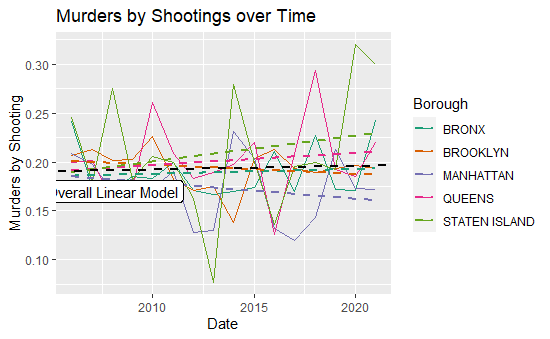
From the plots above, one can conclude that shootings and murders have decreased over time; however, there were notable spikes in 2020, which is especially concerning given 2020 was the start of the global COVID-19 pandemic. Even more interesting, while both have decreased, the percent of shootings that are murders have not decreased, and if anything, are slightly increasing overall.
This leads to more questions on the ratios, or percent, of shootings and shooting murders that other populations are experiences. One could easily replicate parts of this analysis to investigate age, race, and sex related metrics to see if the total and rate of shootings are increasing or decreasing.
One important bias to point out is that this data is in total people. I decided not to find and join borough specific population data over time, so we cannot infer anything about the rate of shootings or shooting murders in a specific borough. This data may also hold the same implicit-biases that the NYPD, and potentially police forces in general have. Similarly, the data may not reflect ‘all’ shooting instances, as it is likely that not all shootings are reported to police.